
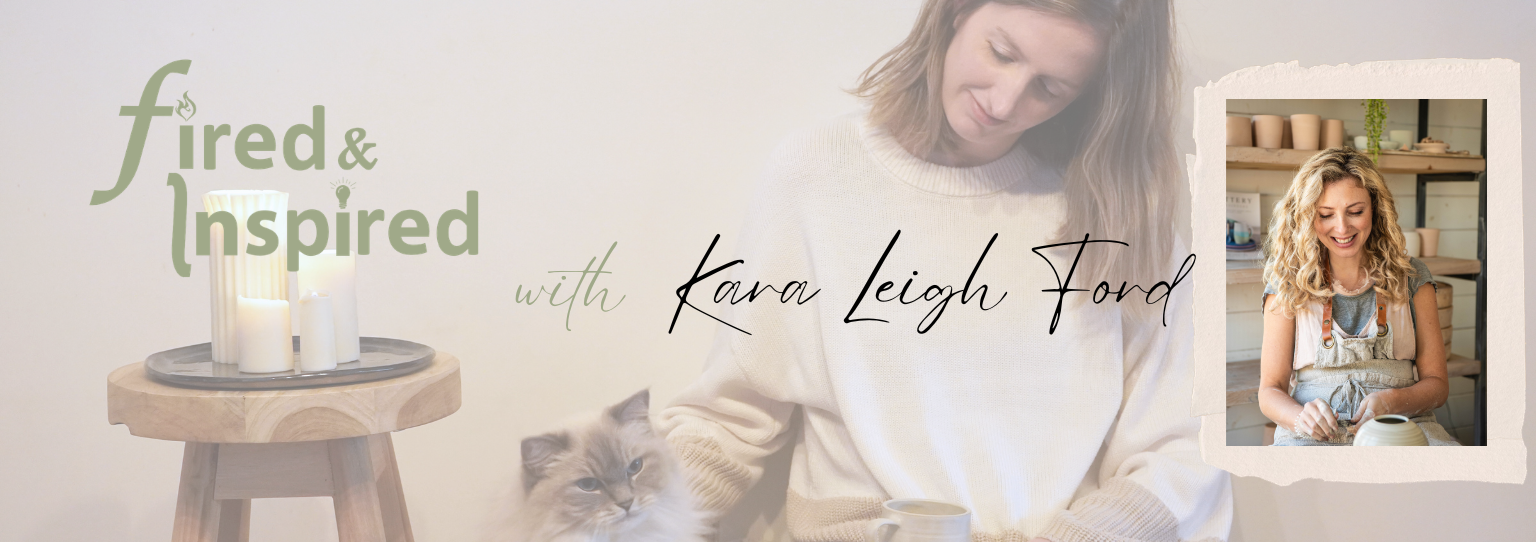
Note: This interview is part of the Fired & Inspired series. All credit: Felien Geldhof & Kara Leigh Ford
If you don’t like where you are, you can change.
Welcome to Fired & Inspired, a conversation series with passionate creatives from different fields. We’ll talk about the sparks that started it all, the fire that keeps them going and what happens in the quiet.
“The universe of creativity is infinite” is what Kara Leigh Ford thinks. She is a full time potter based in Somerset, England. Besides making pots, she also teaches others. We talk about when she fell in love with pottery, the most challenging part of being an artist and running a business, and how the fear of rejection doesn’t stop her. And if Kara would give a masterclass, it would be about unconventional living.
Hi Kara, welcome to Fired and Inspired. We’re going to talk a bit about your creative journey. Like the sparks that started it all, the fire that keeps you going and what happens in the quiet. But first, some rapid fire questions!
Favorite season?
Oh, that’s an easy one for me; my favorite season is summer because I love the long days. I feel when you finished your work day, you have another day to go off and do something else fun. Definitely summer for me and I love being by the sea and just having that warmth of a summer breeze. Being outside is definitely where my heart is.
Early mornings or late evenings?
I am a night owl, so definitely late evenings. Even though I do love when I wake up early and get those extra hours in the day and I get a lot done. I do love that feeling. But I’m not a natural early riser. My default is to work in the evenings.
Last book you’ve read?
I read several books at once. Because I kind of have different types of books going, so I often have a highbrow one that is one of the Booker nominees or something. And then I’ll have a trashy one to go alongside. So depending on which mood I’m in. And then sometimes I will also have a business book. I don’t often want to read that at bedtime because I just want to like switch off, relax.
So the last book I’m reading is called ‘Broken country’ by Claire Leslie Hall. And then the other book I’m reading is ‘There Are Rivers in the sky’ by Elif Shafak. She was nominated for a number of awards. And it kind of follows the journey of a single raindrop over spanning generations and centuries and our relationship with water and the environment. And I think it’s set in London, Syria and Turkey. It’s really fascinating and beautiful, but it’s quite heavy. You have to be kind of in the zone.
Do you think creativity is something we’re born with or something we cultivate?
I actually think everyone is born with it, but creativity manifests itself in different ways for different people. A garden grows where you water it, doesn’t it? So where you focus your energy and your attention, that is where I think most creativity is born out of. I’ll give you an example. One of my friends is in my opinion very creative. She doesn’t think she’s creative at all. She studied languages, so she can speak French, Spanish. She thinks her brain is kind of world orientated rather than art or any of those kind of things. But even though our lives are very different, we have a lot in common. And I can see our commonalities. She had a child and I didn’t. And all of her creativity is coming out in the way that she mothers her child. In kind of the games she plays with her, the baking they do together, the outfits that she dresses her in. All of that creativity is being kind of channeled into her little girl. I think that’s wonderful. And I point that out to her and she’s like, I kind of guess you’re right.
A quote or phrase that sticks with you?
Oh, there are many. “You are not a tree. If you don’t like where you are, you can change.” Those kind of truisms go around in my head a lot.
When was the last time you told yourself well done?
I can’t remember really. I don’t. If you asked me when was the last time that you thought you did a rubbish job? I’d be able to list it. If I had to say one, than I guess my last book would be the one that was a good book.
Do you follow your gut feeling or do you think everything through?
I think everything through. I’m a bit of an overthinker. But my gut is rarely wrong. So if I’m trying to make a decision about something, my gut will be telling me, you need to do this. But I will have to go through the whole thinking process, pros and cons, before I go back to my gut and go, oh that was right.
What is a scent that grounds you? Favorite scent?
I have several. I feel like scents can transport you instantly back to a memory. I love lavender; lavender is something that I’ve always loved and it takes me back to when my nan used to wear lavender perfume. And my mom also kind of made little lavender bags that you put in your drawers. She was into aromatherapy and stuff when she was younger. And I love the lavender flowers as well. I think they’re beautiful. And the fact that bees and butterflies love them. So lavender is probably my favorite kind of natural scent. And then I have my favorite perfume that I wore for my wedding. It’s also the same perfume that my mom wore when she was young. Chloe. It’s like a really old perfume, probably over a century old now.
The Spark
If you would have to introduce yourself to a room of people who do not know you, what would you say? Who is Kara Leigh Ford?
Oh, good question. So, hello, my name is Kara Leigh Ford. I am a potter, and I have written two books about pottery. I teach it and it is my teacher, and I am learning every single day.
When did clay first spark something in you? And how did your journey evolve?
I have always been creative. That was kind of where I channeled my energy into as a child. So I’m dyslexic; I struggled academically at school, certainly in kind of the early years when it hadn’t manifested itself. I was undiagnosed. And then later on I got diagnosed at the age of eight. So I was always told that I wasn’t very good at maths and spelling and words. And I still struggle with word retrieval and things like that. Reading isn’t an issue. It’s kind of more getting ideas from my head onto a page out verbally. So I was always pushed towards the art and creative because that is where I was told you could be good at this. Like you can’t be good at that but you can be good at this. I’ve always loved drawing and painting and making things and imagining things, games, scenarios. I really loved drama when I was younger, but I never touched clay until after university. I did an art degree, but I didn’t touch clay during those years. So during those four years that I studied, it always clashed with something else. I always had a photography module or life drawing or something, that was always at the same time as clay, so I never got to go into that ceramic studio. I always kind of like, looked over and thought, that looks really exciting, but I never allowed myself to go ‘maybe I could do that’. It was only after I graduated university and got an office job, which was very boring, and I decided I needed to do something creative in the evenings. So I signed up to a pottery course and instantly fell in love with it. And I was just like, ‘wow, where has this been all my life?‘ It was love at first sight. I had a really good teacher who’s really encouraging. One of the first things she said to me was, ‘Kara, are you sure you haven’t done this before?’. And that really stuck with me. Even though it was an indirect compliment, it really kind of boosted my confidence and made me go like maybe I do have an affinity with clay. That’s always stuck with me throughout. Now when I teach, I try and be really encouraging and try and find a spark where I see potential or where I see someone has got a good feel for clay design or something. I try to find that and reinforce that confidence so that they can take that into their pottery life if they decide to. So it all started 20 years ago.
I was just like, if they can do it, maybe I can do it too.
Kara Leigh Ford
And was there like, a specific moment you knew I want to do this as a business?
So when I had kind of an epiphany of ‘oh people actually do this as a living’ was when I applied to the first series of the ‘Great Pottery Throwdown’. This is way before anyone knew what it was, no one heard of it, it wasn’t a thing. I just saw a little poster in my local pottery supply store advertising for people to come and potentially be on this show, which is about pottery. And I was like, oh, that’s kind of cool. At that time, I still had a day job and I just applied. You had to send some pictures of your work in and then do a little write up. I got through, I got down to the screen testing and I got down to the final 20 people. But I wasn’t comfortable with a camera in my face and you know, a production assistant and a mic kind of hovering over your head and then having to throw a pot at the same time and answer questions. It’s really hard. So the people that actually get on the show and do it, are really potters because they have so many other things at once. But I loved meeting the other people in the audition round, chatting to people and getting to understand what they did. There were so many different ways of making a living from clay that I just never even considered. So there was someone who worked in a ‘paint your pottery’ shop part time, there was someone who was a technician at a school. There was a chap who was an artist in residence at a private school. There was someone who was doing baby sculpture type thingies. And I was just so impressed that all these people were in a way making money out of clay. And I was just like, if they can do it, maybe I can do it too. So that was kind of an epiphany moment for me.
And when did you start with a business?
That was 2015. Eleven years ago!
Living a creative life can be beautiful and powerful. But it is also demanding. What fuels your fire today? What keeps you going on the very busy or sometimes even hard days?
I think stepping away is really important. And something that took me a while to learn is, you actually need to come away from your work in order to get inspired and reinvigorated and to bring fresh energy back to the studio. So it is really important to stop making and stop being in my studio and have a break, go and spend time with nature. I have a horsey friend that I hang out with and it’s really important when I go out to her. I’m not on my phone, I’m off the internet. And doing things like that really recharge me. And spending time with my husband walking. We have the best most creative chats when we walk and that really energizes me. I get loads of ideas and then I want to come back to the studio and implement them.
What is the most challenging part of being both an artist and a business owner?
Oh, the most challenging part is the marketing. Even though that is what I did as a day job, I kind of paid the bills with that, ten years before I was a potter. So I think I know what I’m doing with it. It’s the constant cycle that never ends. You know, it’s not like you start a pot, you throw it, you put the handle on it, you fire it, you glaze it, you fire it again, and then it’s finished and done and then it goes off to his forever home. And you rarely ever then think about that part of her again. The marketing with business is just a never ending cycle and you can never do enough. Things are just changing all the time in the wider world and in the landscape that is being a small business, being a small artist. It feels like you have to pivot so often and you’ve only just kind of like got your feet under you and get the grips with something and then the world will change again and you have to like do it all again. It’s exhausting sometimes. It’s that constant cycle of I’m getting the hang of this, I’m getting the hang of this,…No, I’m not.
That’s true. I struggle with marketing, it’s sometimes so demotivating. Like for example, you put so much time in making a reel and then you get so little views.
It’s so frustrating. And the tech as well I find really infuriating because yesterday, for example, I spent an hour creating a reel and it saved and it disappeared in the app. I was just like for goodness sake. So I recreated it this morning and tried to post it this morning and it had like a little thing saying, something went wrong, we’re gonna try again later. And I was like, what do you mean something went wrong? I still haven’t been able to post this darn reel. Things like that really kind of like set you back, don’t they really? Because you plan a strategy in your head and now I’m a day and a half late in my marketing. So that’s like all messed up everything. So thank you Instagram.
And also it’s like the big accounts keep growing, but the smaller accounts are like stuck because nobody sees their content.
Yeah, I know. Unless you are a full time content creator and let’s say it’s your job. I think it’s really hard when you actually have another job. And you know, Instagram is only like really supposed to be a small part of your day, rather than the entire day. I think it’s really a disadvantage and it’s really difficult. You have to try and make it more organic again for yourself. Like in terms of just sharing authentically and being like, this is what I’m doing right now. I’m just going to share that and go with that rather than trying to make really big kind of complex projects. Because otherwise you just get too overwhelmed and too frustrated with it. And I think showing up is just good enough sometimes.
Showing up is just good enough sometimes.
Kara Leigh Ford
Do you feel like pottery has changed you as a person?
Definitely. I’m a much more patient person. I think I’m more accepting of failure. I think that pottery has meant I take life at a slower pace. It’s physiologically, it’s helped my brain. It is so healing and so meditative that I actually think I am a better human. At cellular level, because I do pottery every day.
About fear and just doing it
From personal experience, I know there are lots of fears. Like when I want to bring something into the world, I always have the fear of it won’t be good enough, nobody will buy it. How do you handle fear or how do you look at fear?
Well, Elizabeth Gilbert has got a very good quote from Big Magic. I think it’s something like, fear doesn’t drive my car or never let fear drive my car. And that’s another kind of saying that has stayed with me. So even when I am fearful of putting a new thing into the world, I will never let that fear stop me. I will never let the fear of it potentially failing stop me from doing it. And I think that has really kind of been a motivator throughout my creative life. You know, what is the worst that can happen? Often the worst that can happen is completely outweighed by the possibility of something amazing happening. So, you have the bad thing potentially happening over here, which in reality is no one sees it, no one buys it. That’s really like the worst that can happen. Then you have the amazing thing over here, which is everybody loves it or a lot of people love it. You sell out and people are demanding you to make more. Like that’s the most amazing thing that can happen. And it’s just much more motivating than this. So I’m gonna focus on that.
The foundation of fear is, fear of rejection.
Kara Leigh Ford
Do you, as an experienced potter, still have that fear, to bring new stuff out in the world or are you like ‘I’m confident enough to show my work’?
I feel like I’ve done it enough times that it’s a muscle that I have exercised and I’ve strengthened. So I don’t necessarily have a fear of showing my work to the world just because I am very practiced at it. I had to do it lots and lots of times. I guess there’s always the underlying pain of rejection. The foundation of fear is, fear of rejection, isn’t it? I think that’s always going to be there, but I think that’s just human nature. I don’t think you can ever really fully get over that. You just have to be okay with living with it and being more focused on the process and what you enjoyed and sharing that. And then just hoping that enough people feel that spark of enthusiasm and go along for the ride with you. Even if it’s just one person, you know, tells me that they like my work, that’s normally enough for me to go, oh, okay.
So did you have a fear that held you back or made you postpone something in the beginning of your career?
That happens all the time. I mean, there will be so many things that I think, I should share that on social media or I should write about that in a newsletter. And then I just don’t. And I’m like, why didn’t I do that? Why didn’t I just share that? And at the very heart of it, I actually think it’s not procrastination, it’s not laziness. It’s not any of those things. I think it is the fear of rejection. I think it’s putting something out there and then not being seen or not being heard. And that is the one thing that us artists really do need. We need that. We are putting an expression of ourselves out into the world. And even if, you know, artists say, just create for yourself, don’t create for anyone else. That validation is really important. And because it’s about connection, it’s about getting something back. As human beings, we can’t avoid that. Like, we’re not designed to live in isolation. So to have that communication back and forth about our work is really important. I think at the end of the day, when I have held myself back from sharing something or from writing, it’s because it’s easier to stay small than to put yourself out there.
How did you get over? You just do it?
I think sometimes I just have to have a word with myself and say, ‘just get over yourself’. No one’s really looking anyway. No one really cares what you’re sharing, so just share it. And then hopefully it resonates with a handful of people. So that’s what you need, right? A few people who just interact. I did a course, maybe five years ago with an Instagrammer called Sarah Tasker. I don’t know if you’ve ever heard of her. She’s not actually on Instagram very much anymore, ironically. But her course was about Instagram and how being good at it and being good at marketing in general. And one of her sayings that stuck with me was ‘you only need a thousand people to spend a hundred pounds each a year with you to have a hundred thousand pound business.’ Isn’t that mind blowing? Like, oh my God and it feels totally doable then, doesn’t it? Not that I have a hundred thousand pound business, way far from that. But actually even if you have half that, you just need like a thousand people to spend £50 with you a year, then you’ve got a 50,000 pound business.
Sounds so easy.
Yeah, it feels so easy. But it is about nurturing the few rather than appealing to the many. And I think that is an important thing. Small makers like us, we’re not interested in scale anyway. We’re interested in small groups and we can only make on a small scale. So if there’s no point in us trying to appeal to millions and go viral, like, who gives a toss whether you go viral anyway? Like it’s meaningless in the grand scheme of things. Having a video go viral on social media; you might get a slight uplift in sales for a very short period of time. That doesn’t do anything for you in the long term. Nothing. So stop focusing on that. That’s just such a hollow goal.
I think sometimes I just have to have a word with myself and say, ‘just get over yourself’.
Kara Leigh Ford
No one’s really looking anyway. No one really cares what you’re sharing, so just share it.
Recharging & Uncertainty
When things slow down or you had a busy day at work. How do you take care of yourself?
I spend time outside, just recharging, just being with trees and animals, chilling with my husband. We love walking, that’s one of our favorite things to do in the universe. And also, being in my early 40s now, I know that I need to look after my body probably better than I did in my 20s and my 30s. So I am being more mindful of what I put into it and I will try and be active at least a few times a week. I think that is really important. Also spending time with people. As a solo artist, it can be very easy to go for days and not really speak to anyone. My work pulls me back quite a lot and I could quite easily take a rain check on that coffee date or dinner date that I’ve made with friends because I’ve got so much to do. I’ll always have so much to do. And those relationships are so important to nurture and to keep and to make really strict boundaries around and protect them at all costs. Because at the end of the day, if this all finished tomorrow, I’d still have those people. And that is the most important thing.
Yeah, that’s true. Are you still able to relax when you’re throwing or are you focused on this is for the business?
Yes 100%. I love throwing. I find it very meditative and trimming as well, put handles on. Even things that used to stress me out, now I find a really lovely process to go through. One of my favorite things to do is, to just put an audio book on or the radio or music and get into that flow state. Sometimes I just have my windows and doors open and just listen to the birds. You know, I can sit there for hours and hours and hours and do it. I think the one thing with throwing is you have to make sure that your clay is soft. If your clay is too hard, you’re never going to get into that flow state because you’re always going to be battling against your clay. So make sure the clay is soft and you’ve got all your tools that you need around you. You’re comfy, the temperature is right. Then you can really get into that zone and time just flies.
I’m kind of over here with no pension, no holiday pay, no help, no sick pay.
Kara Leigh Ford
But the freedom that I have is just priceless to me.
Everyone has moments of uncertainty. I think people who have a creative life have maybe more uncertainty. How do you stay grounded when you have a period of uncertainties, like you’re selling not enough, how do you keep going?
I agree to that to some extent, but I also feel like employment in the traditional sense of the word is almost like it’s a fallacy that you have more security. I actually don’t think you do, because things like the pandemic happen, and then companies fold, businesses struggle. Making people redundant all the time. The world just changes in ways you never expect. And I actually think that there’s insecurity in every scenario, and I think there’s levels of security as well, isn’t there? So if you are employed by someone, your insecurity could actually come from just having a very rubbish boss. Or being unsupported in your company or unsupported in your role. And your day to day can feel very uncertain and very confused and quite stressful on a kind of micro level rather than a macro level. And yes, obviously artists, our paychecks are, they’re not as regular and they’re not as kind of dependable in certain ways. But on the flip side of that, you are in control of what you can earn. As long as you work, as long as you are doing the thing; you’re putting it out there, you’re gonna make money. It might not be in the way that you think you’re going to make money. But you’ve got to keep working at it, keep innovating, have different levers that you can pull at different times. You know, don’t just put all your eggs in one basket and think, this is going to be my money maker. Because that often isn’t the case. You’ve got to try lots and lots of different things. At the end of the day, I kind of feel that employee employment is a bit of a trap. I’m kind of over here with no pension, no holiday pay, no help, no sick pay. But the freedom that I have is just priceless to me.
Quiet & Connection
You’re surrounded by creative people. What has connection with creative people taught you about creativity?
Oh I think it’s teaching me something new every single day. Sometimes those same lessons show up again and again and again. For instance, the fact that creativity never runs out. It’s not a bucket, it’s not finite. It’s never the end. There is always more to discover and more things that you just haven’t yet been inspired by. So I know Elizabeth Gilbert says in Big Magic that sometimes ideas will kind of float around in the universe. I’m paraphrasing here, but there’s like ideas floating around the universe and if you don’t grab onto an idea, it will go and find someone else ready to go with that idea. And I love that. I feel like creativity is just energy and you have to spend it in various ways and invest in it and sometimes you over invest and get a little burnt out. But I think that being surrounded by creative people and having pottery peers who I chat to regularly on the internet or certainly when I am lucky enough to meet up with them, is that it’s just infinite. Like the universe of creativity is infinite. And that is just so inspiring to know that you just don’t have to do it like everyone else. You can do it in your own way. And isn’t that wonderful? Isn’t that amazing that you just don’t have to be the same as everyone else? You can just be you, be individual and express yourself in any which way that you want.
That’s beautiful. When you start a new pottery piece, how do you begin? Do you plan it, draw it or do you just feel the clay?
I tend to sketch out on the wheel itself. Even though I’d love to be one of these potters who does detailed sketches on graph paper. And I have done that. I’ve got my book here that I have a few drawings in. For a person who had an art degree, it’s pretty rosy. But I’d love to be a person that sketches things out on paper first and then takes it to the wheel. But I find it much more useful to just sketch it out on the wheel in the clay because there’s other elements that you have to consider like gravity and you know the actual material itself. I’m never going to get that from a sketch. So sketch is like, it’s all well and good and it’s great, but is it actually gonna work in physics? So I just find it easier to like play around on the wheel and come up with a new design that way. And often it doesn’t turn out how I had it in my head, which is okay. Things develop, things move on and limitations often breed creativity, don’t they? And you don’t know what those limitations are until you’re trying it and seeing it. This needs to be slightly different for this reason, that curve doesn’t quite feel right. Change it. So generally I am sketching things out in clay and often I’m quite impatient. I want to get an idea out as soon as possible. And I remember to chill out a bit and make something, create it, but then sit with it for a while before I actually go that’s the one. Because often, it’s when I’m in production and when I’m making it to sell. Maybe a few batches down the line, that’s when I come up with, oh, no, this is better. Everything is always improving on you. So every batch, every consecutive batch is going to be better than the last, you know? But I think maybe I’m just a little bit impatient. I want to get it alive.
What is that the favorite part of the process of pottery? Is it like the shaping, the glazing, or seeing the results?
Oh, what is my favorite part? I quite like constructing at the moment; hand building, putting handles on, piecing things together. Because that feels like it’s so close to being finished. And you can actually hold it in your hand and go, oh, that’s a teapot now. Or that’s a mug now, because it’s got a handle. So at the moment, I feel like it’s the construction phase, but then again it changes all the time. Sometimes I feel like I really enjoy throwing and then other times I really enjoy trimming. It depends on what mood I’m in really.
What has pottery taught you about patience and imperfection and letting go?
Oh, my gosh; Everything. Patience is one of them… Pottery does not like being rushed. No one has ever made good work from rushing it. Something always goes wrong when you rush. And to not give yourself arbitrary deadlines as well. So don’t. I just try and kind of let go of that. Like I have to have this next shop update by this date. Why don’t you give yourself a little bit more time and actually enjoy it and do the best job you can of the marketing because that’s important. And letting go. I feel like I am pretty good at moving on when something goes wrong because I don’t hold it against the clay. I don’t like to get annoyed with the material. It’s always my fault. Like when something goes wrong, it is very rarely that there is actually something wrong with the clay. I admit to being like frustrated and angry in the moment when I pull something out the kiln and it’s stuck to the kiln shelf or cracked or whatever, but I’m just like, it’s okay, I’ll make another one. It’s fine.
Where do you think confidence and creativity meet?
From doing it. So it’s like a Venn diagram. So creativity is over here, confidence over here. Doing it is in the middle. That brings it together. You literally just have to do it. You have to spend hours doing it creating. Your confidence is never going to grow if you don’t do it. If you don’t experiment, if you don’t be with the material. And I think that is true with every part of the business as well. You have to be more, you have to just do it to get confident in the marketing. You have to do it to get confident in writing. You have to actually do it to get confident at things like this. That is the thing, isn’t it, where like motivation doesn’t come first; action always has to come first. Like if you’re not motivated to do something, you’re never going to do it. You just have to start.
Growth & challenges
If you look back at the Kara you used to be and the Kara you are now, what is something you used to believe about yourself that you outgrown or something you had to unlearn about yourself to keep growing?
I’m not very good at writing. That was a very deep held belief, I’m not entirely sure it’s 100% squashed. I think now that it’s evolved into; ‘I just take a very long time to write’. So it’s not that I’m not very good at it, it’s that it just takes a very long time.
What helps you to keep learning and growing?
Travel. Just always remember, you don’t know all and there’s always stuff to learn from others. I think going and doing things in person is just so valuable. Like, I did a wood firing course over the summer; down in Devon, which actually took place over five consecutive weeks. And it was just absolutely brilliant. I loved every single minute. And it was the meeting, the people chatting about pottery, learning the technique was just kind of like the icing on the cake, really. It was all of the other things that came with it. And I think that that really just reminded me that, to get out and do things with other potters, with other creatives, is just so valuable. And I can feel my brain cells, like, fizzing when that’s happening. So I think to get out of my studio and go and do something different, creative, exciting, somewhere else, a different location is how I keep moving forward.
Do you sometimes have growing pains?
I think growing pains probably happened earlier in my business because the last few years there hasn’t been much growth around here. I’m not gonna tell you any lies. You know, things have stayed relatively on the same level, which is fine. You know, that’s better than the other direction.
So I feel like growing pains happened earlier on in my business, and I think that just happened with the big lessons basically. You know like having an accountant and messing up my taxes, that was a pretty big lesson. And then doing a really big commission for a company and then not pay, not charging them enough shipping. Like, those are all kind of like the growing pains that really feel like they sting at the time. But they’re good lessons to learn.
So sometimes when I’m shaping clay, it doesn’t work out. Did you ever hit a moment in your journey where you had a break down, but then it led to more clarity.
In terms of, like, throwing the clay across the room? Breakdown?
Yeah, quite often. I think it’s moments of frustration and challenges that you kind of got to walk away from, give yourself a little bit of breathing space, and then come back to it the next day. I often have this really. I have this really weird thing. I don’t know whether you’ve experienced this, but I talked to my husband about it and he’s never had it. If I have a problem, often pottery related. And it’s something that I’ve been mulling over in my mind, and it’s going backwards and forwards, backwards and forwards. And I don’t know what the solution is. If I sleep on it, the solution will often come to me in a dream. It’s really weird. And I’ll wake up and I’ll know the answer and I’ll be like, oh, that’s it. I think maybe it’s not like mystical, magical. I think it’s actually giving your brain a chance to rest and reset and your subconscious is really powerful, isn’t it? There will be things going on in your subconscious that you’re not aware of and your brain is kind of working things out. Like cogs are turning all the time and then all of a sudden it will just offer you up this ‘Have you thought about this?’ And I’ll literally wake up in the morning, and I’ll be like, I know what to do now. But maybe that’s just having a good night’s sleep.
What role does experimentation play in your growth as an artist?
Well, I’m experimenting all the time. Something will spark my interest and I will want to explore it. So whether that’s a new clay, new glaze. You know, I have literally hundreds of photos on my phone where I’ve been just out walking about and I’ve seen the shape of a pot, whether it’s drawn or whether it’s an actual pot. And I’ll take a snap of that and I’ll be like, I’m gonna take that back to my studio, and I’m gonna try and do something with that. Because that’s interesting. So, yeah, all the time I’m experimenting, and I have a backlog of things that I still want to experiment with. I’m adding to that bucket all the time.
How has your work evolved from the moment you started to now?
It’s really changed. I think it’s probably unrecognizable from when I started. I kind of hope it is, in a way. As you do more of it, you get better, and then you refine things, you change things. You know, my handles are really different from how they used to be and they’re changing all the time. Even if it’s just a tiny little bit, things are always refining and always, always improving. If you put a pot from 10 years ago next to a pot now, maybe there would be a vague thread of connection there. But I’m not really concerned if there is or there isn’t. Like, what interests me is, what is pushing forward and looking at the new.
Finish the sentences
I feel most alive when… When I’m out in nature.
One thing I’ve learned again and again is…. To keep going. Never, never give up. Keep going. Keep following your dreams.
I’m still figuring out… Everything.
In your own words: Creative living is… Creative living is freedom.
If you could give a masterclass, in what would it be?
I think I would give a master class in unconventional living. Like, I know I’m not that unconventional. I don’t live in a tree house or anything, but unconventional in the sense that, I’m self employed, I do a job which is quite unusual. My husband and I strive for different things than lots and lots of other people. We don’t have children and it’s a very deliberate decision that we don’t have children. And I think that that is jarring for some people that kind of like, oh, you don’t have kids. Why? Like, why, why, why? And I think that to show people that fulfillment can come from so many places, that it doesn’t have to be pinned on the regular things that society tells you it should come from. Like money and all the regular things; like you have to get married, you have to buy a house, you have to do this, you have to do that. Actually, no, you don’t. You don’t need to do any of those things. You can do whatever the hell you want. And society kind of makes you feel bad about those decisions sometimes because questioning your decisions is the standard rather than you questioning theirs. Like, so why did you have kids? And lots of people actually when I’ve kind of flipped that, don’t have an answer. They say, oh, well, it’s just because that’s what you do. Really? Okay. That’s not a good enough answer. So, yeah, those kind of things, I think would be in my master class.
What is next for you? What would you do or create if there were no limits?
If there weren’t any limits. Oh, my God. Well, I’ve often thought about creating a public pottery studio in my local area that is accessible to lots of people and has all the beautiful equipment that people can use and come in and learn. Offering workshops and tutorials and in life events like, that would be amazing. But I feel like in reality that if there was no limit, I would literally clone myself. And get other Kara to do that. That would be amazing. And they’d really enjoy that. But for me, I love making pottery just too much. And I know that that other Kara would basically be managing kind of a very different business. Which would be fun, but there would be very little space left for actually just sitting on the wheel and creating. So if no limitations, I would clone myself and do that, but I would also keep this Kara doing a similar thing to what I’m doing right now.
Before we close, I’d like to ask: if you could leave just one spark – one thought or feeling – for the people who will be reading this, what would it be?
Oh, I think we’ve got to go back to Elizabeth Gilbert?! Don’t let fear drive your car. That is the quote that I would leave with people. Just because something is scary doesn’t mean you shouldn’t do it. In fact, that should be the thing that kind of points your attention. The thing that feels scariest is often the thing that you should be doing. So, yeah, don’t let fear stop you from doing anything in life, because that’s where regret comes in.
Kara Leigh Ford’s official social media platforms are:
Instagram: Karaleighceramics
Patreon: KaraLeighFordCeramics
Youtube: KaraLeighFord
Facebook: KaraLeighford
Pinterest: KaraLeighFord
Website: karaleighfordceramics
Felien’s social media platforms are:
Instagram: feliengeldhof
Pinterest: atelierfelien
Website: Atelier Felien
© 2026 Fired & Inspired.
Interview & video content by Felien Geldhof & Kara Leigh Ford
All rights reserved. This content may not be copied, reused, or redistributed without prior written permission.