
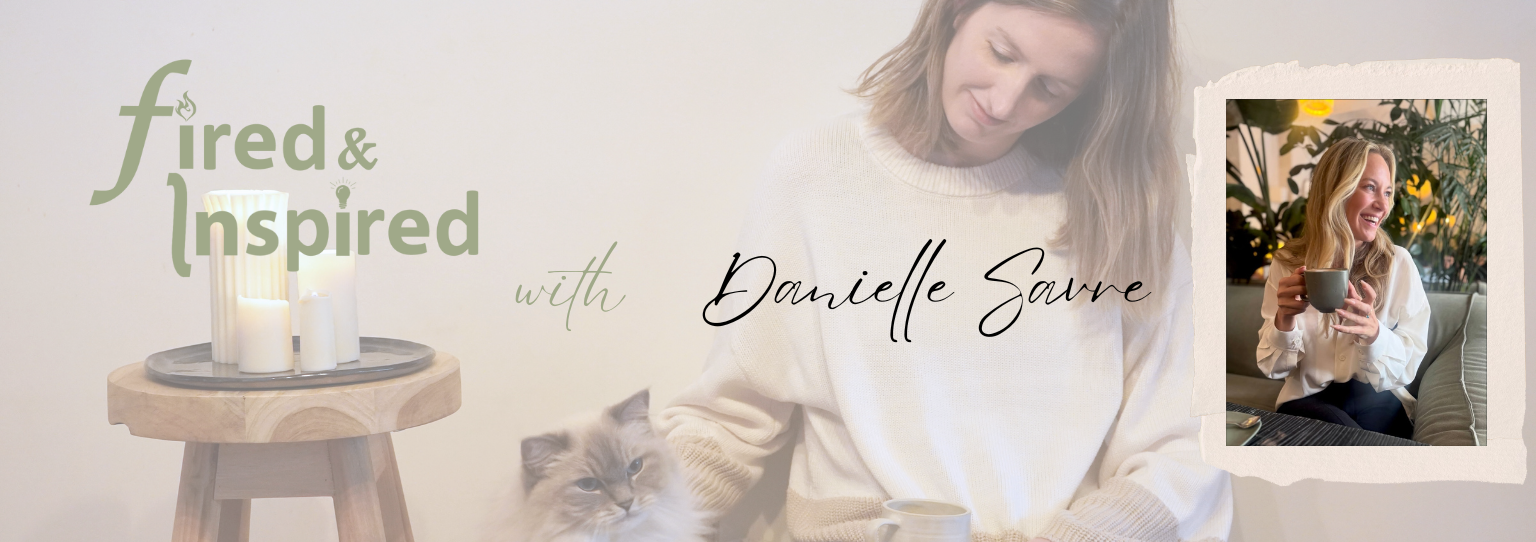
Note: This interview is part of the Fired & Inspired series. All credit: Felien Geldhof & Danielle Savre
Live life like there’s no tomorrow
Welcome to Fired & Inspired, a conversation series with passionate creatives from different fields. We’ll talk about the sparks that started it all, the fire that keeps them going and what happens in the quiet.
In this first part of my talk with Danielle Savre, she shares what it really feels like to live as a multipassionate creative, moving between acting, directing & writing music. We talk about why collaboration fuels her, how much she loves directing and the quiet vulnerability around HEaRD. A shortfilm she created with ‘ease’, but hasn’t always felt ready to talk about. She talks honestly about fear and why she refuses to call anything a failure.
You can read part 2 here
Hi Danielle, welcome to Fired and Inspired. We’re going to talk a bit about your creative journey. Like the sparks that started it all, the fire that keeps you going and what happens in the quiet. But first, are you up for some rapid fire questions?
Yeah, let’s do it. Starting with the rapid fire!
Favorite season?
I don’t know; winter or spring. I live in California, so it’s hard to say. Our winters just finally get cold and they probably feel more like everyone else’s fall. But that transition from winter to spring is such an amazing time of year. It’s almost like the transition itself is what I love. But I love winter because of all the holidays that happen during the winter time, from Thanksgiving to Christmas, and then even at the tail end of winter, you’ve got New Year’s, you’ve got Valentine’s Day, like so many holidays and moments where everyone gathers around and around the fireplace and all those kind of things. So I think I love what it represents. But that transition between winter and spring is pretty special too.
Do you think creativity Is something we’re born with or something we cultivate?
Fantastic question. I think we’re all born with it and I think based on our circumstances, we have the means to cultivate it or not. But I think everyone’s born with it.
What is a quote or a phrase that sticks with you?
So many. But live life like there’s no tomorrow is one that resonates with me on a constant base. It’s a little bit of a way to kind of live life in general. That can be interpreted in different ways, but I think it ties into being fearless and just going for it in the moment. But there’s so many fantastic quotes out there that I butcher and can never remember until I’m like, oh, that’s a good one. I need to write them down.
Do you follow your gut feeling, or do you think everything through?
I am someone who thinks everything through too much. I overanalyze everything. But I do, when it comes down to the final moment, I do trust my gut. I wish I’d sometimes just acted on my gut, but I do tend to overanalyze too much.
The Spark
If you would have to introduce yourself to a room where people do not know you. What would you say?
I’d start with my name is Danielle Savre and I’m an actress. I need to work on that because my profession does not define me. But I do usually start with that because it’s something I’m also very proud of. I’m a California girl, as much as I tried to fight against that. And I’m an actress, director, creative artist in general who loves to travel. I would then talk about my friends and family. You know my best friends all moved away from LA and from me, but I love to travel to see them. And I would just say I’m someone who loves to live life.
Let’s talk about the start of your creative life. I know you’ve been in the acting business since you were 7, but do you know the moment you knew ‘I want to do this for the rest of my life’. Was there a specific spark?
I’ve had an interesting journey because I started so young. It really just happened because I was this bubbly kid that really kind of lit up in front of a camera, sassy, and I can hang with the adults and the whole thing. So it started from that. But I would say when I had a pretty big fall from whatever you want to call it, I hit rock bottom at 19. I really had to choose, is this what I want? And I would say that was the biggest testament to ‘is this really what I love and what I want to do?‘ Because when you’re younger, you kind of just weirdly fall into it. It just kind of happens, and then you kind of just roll into the next thing. When all of it kind of went away, the universe kind of went ‘Do you want this? And if you want this, this is what you have to do. You have to bust your butt and the whole thing’. And I was able to get back to what I love about the entertainment industry and my passion for it. So the spark kind of came from losing it all and then realizing again how much I loved it. But I was a kid who always, I will say, sat in front of the TV too close. Like, it’s probably why my eyes are so bad. I was someone that would get lost in watching shows and movies. So I was always someone who was completely connected from that standpoint in watching stories and the art of storytelling. It was always there and I always loved it. But I found that real spark when I lost it all. And then I was like, oh, my God, I love it. I just delve into, like, watching every movie and reminding myself of why I loved it.
I found that real spark when I lost it all.
Danielle Savre
So I heard it was Paris Barclay who asked you if you wanted to direct. What was there specific about directing that you wanted to do?
I would say as an actor, you don’t have a say. I would say you have the power to control your performance and that’s about it. Which is powerful but you don’t have a say in the process as a whole. And I struggle with that sometimes, maybe because I like to kind of control things and overanalyze the whole thing. But really it’s because I love to collaborate. When you collaborate as a team, you really come out with better results, a better TV show. The final result is something so much better than what your own individual idea was. As an actor, you sometimes collaborate with your scene partner if they’re willing to be open and collaborate with you. But a lot of times what ends up happening is you kind of come to set, you hit your mark, you say your lines, you do what you kind of were planning on doing with your role, and that’s it, you walk away. You have no say in how anything else goes. Sometimes that’s great because you can take your hands off and there’s no responsibility. But I really love the whole process from start to finish. I love pre production, I love post production and I love being able to collaborate with an entire team of sometimes 300 people. I would always sit at village and watch DPs, directors. I was just led from this place of curiosity that I always wanted to know more. And that’s what Paris picked up on. He’s like, do you want to direct? Because what I realize now in hindsight is, so many actors don’t do that, which isn’t a bad thing. It’s just, I didn’t think I was different for doing that and I’m realizing that that was such a unique thing that Paris picked up on. So it really came from my love of storytelling and my love of collaborating. There’s something with acting that you just miss because you come, you do your job and you leave.
So I guess you have more creative freedom as a director?
Yeah. I mean you really do not have a say as an actor. I think people do think we have, because we’re the face that ends up on screen. People assume, oh, you’re the face, that you have all this say. You don’t. I mean, if you’re big A list stars, obviously, they have a ton of say. But at my level, they expect you to do your job, hit your mark, say your lines and go. And how it’s edited and how it’s done can be manipulated, whatever which way they want. So you kind of lose a little bit of that creative freedom. This is a great way to put it when you’re just acting, whereas when you’re directing, you really get a say in the entire process with the other 300 people. Directing is really a beautiful thing. And because I probably am very good at making decisive decisions and hearing people out. And I think that that is something that has really benefited me as a director.
You’re also a songwriter and a musician. How did that all start? How important is music to you?
I loved it. Music was a thing early on that I probably loved a little bit more than acting in the beginning. It obviously switched. It’s so funny we’re bringing that up. I had the creative freedom to write these songs and the songs came from a place of my heart. Every song I wrote with Alex Nestor or with Jack D. Elliot or any of the producers I worked with, I got to speak about my story. Like, what is it I want to speak about in the world? So there was something really powerful about that. I love putting it together because just like television and films, you’re telling a story through music. I just loved that and I love that you kind of get to hide a little bit behind the interpretation of the song. You kind of get to go, okay, I’m gonna write a song that means a lot to me, but really, at the same time, it’s extremely interpretive to the person listening to it. So I love music. I love that I could sit down and do it at any time. You don’t have to get hired to write a song. You can sit there and just write a song with a friend and a piano. There’s something very freeing about that. It was something that I could do on my own time with my friends. It felt very expressive.
Does creating music give you something that other creative forms doesn’t give you? Probably the freedom then, I guess.
I think the freedom, yeah. There is a freedom to music that you just don’t have in other mediums. I think acting you can, but you’re kind of limited unless you’re acting in your own house by yourself with no audience. Like, acting is kind of something that is meant to be performed in front of at least an audience of one, whereas music feels like this thing that can be very personal. That you can kind of just have yourself and a piano player, guitar player, and just jam out, and it’s very therapeutic.
Are you ever going back to being a songwriter, musician, you think, or is that something that is on hold?
I struggle with the fact that I, of course, want to do everything, but there’s just time. I think it’s really beautiful. I get to see Kevin, my partner. He every once in a while goes on stage and performs and just gets something out of it. It kind of inspires me to go, oh, you can kind of just do a gig every once in a while at, like, at a local place and get your friends together. So that element of performing is something that I’ll maybe always hold on to because it would be fun to do again. I know Alex wants me to do a live performance with her for the song that we’re releasing. So there’s things like that. But I think getting into the studio and recording another album might be just part of my past. But I do love songwriting. If someone wanted to sit down and do some songwriting with me, I would jump on that in a second. Because I found that to be something that I really connected with and I seemed to have kind of this natural knack for which was cool. I was like I can do melodies and choruses and verses really easily. It came naturally. We’ll see. I go through waves. Lately I’ve been like, no, absolutely not. Music is over. But I think when you’re an artist, kind of every element of art kind of creeps into your life at different times, depending on where you’re at in your life.
I think when you are an artist, every element of art kind of creeps into your life at different times, depending on where you’re at in your life.
Danielle Savre
You’re a multi passionate creative. You’re an actor, director, musician, storyteller, activist,… What does it mean for you to live like a multi passionate creative? How important is it to you to be able to do what you want to do?
It’s fulfilling. I mean I think as an artist to be able to do it all. And I’ve been so privileged and lucky to be able to do it all in a sense of like, making a living off of it. I mean, it’s fulfilling. I’m living my dreams and I’m really, really grateful to that. I don’t know why that almost makes me emotional. It’s pretty powerful to be able to say, I get to do it all. It’s pretty beautiful and extremely fulfilling. I just hope that I continue to get to be able to do it and that it continues to resonate with people in some capacity. I love it. Like you said, everyone’s kind of born with it. I wish more people tapped into it because I think a lot of times we hold back. We have that imagination when we’re younger, and it kind of dissipates and goes away as we get older. We lose that creative freedom that we innately have.
As you know, living a creative life can be beautiful and powerful, but it’s also something that is quite demanding sometimes. What fuels your fire today? I know you’re having a downtime a bit, but…
What fuels me is just what it does. I mean, you know what that’s like? When you create art it just gives you a sense of purpose. Like there’s this weird feeling of you that’s kind of like this all makes sense, everything clicks. Like, art is one of those things that just feels right. And so I think that’s what fuels me. The act of just acting, of singing, of dancing. There’s something that feels so good about those things. That in itself, the act of doing it is what fuels me to want to do it again. It’s almost like I don’t want to equate it to a drug, but it’s like endorphins. It releases these chemicals that I think really are something that I continue to strive for because it’s just so fulfilling. It feels like it gives me a sense of purpose. And that in itself is what makes me to want to do it again. And that sense of purpose really is that, whether it brings a smile to people’s faces or it feels therapeutic, I think we all can kind of come together around art. Whether it’s an art gallery or a piece of art or a movie or a TV show. It brings people together, and it allows people to really think and come from a place of curiosity and kind of spark that imagination that we had when we were younger that we kind of lost. I love it and that’s the fuel that keeps me going.
When I begin shaping a new pottery piece, I usually have like, an idea in my mind or sometimes, you know, the clay decides what it wants to do. So I’m wondering, you’ve played roles across different genres, how do you approach a new role? Is it some kind of structure you follow or a routine or something like that? How do you shape a new character?
The first time I read something, it’s completely instincts and gut, which is interesting because you asked that question earlier. Do I ever go with my gut? And when it comes to acting, that is the original. The inception comes from going with my gut instinctively. When I read this character, what do I see? What do I feel? How do I hear this person in my head? Who is this person, who in my life reminds me a little bit of this person? So I think that’s where it stems from. And as time goes on, you start to make choices that are more definitive. Like, you’re saying at first, I’ve never done ceramics. But from what I understand it kind of starts off with your hands. You just start to do what you were thinking. And then as you start to go, it becomes something more, something bigger or sometimes you fall flat on your face. You’re like, that one was a bad audition on my part or that was a bad scene that day. What I went with was completely wrong or thank God there was a director there that put me on the right track because I was off track. So I think it all comes from gut and instinct at first when it comes to acting and even directing. But then over time it kind of morphs into something more structured or more defined as to who this person is and how this person talks and things like that. But it also evolves, I mean, Maya, over seven years, she evolved. And I think that’s kind of important too. So many times I hear actors say, my character wouldn’t do this. But humans change, they evolve, they shift. I think also keeping that open minded element of a character is really important too. It’s constantly changing. Just like it’s interesting that, you know, with clay you’re molding it, it’s constantly changing.
I wonder, so you played Maya for seven seasons. Are you like able to let her go totally when you have a new role? Like when I make pottery, like let’s say 100 pottery pieces. They usually have something similar, but they’re still different. Do you take Maya with you? You know what I mean?
Yeah, I do. Every character I’ve ever played, I’ve grown as a person while playing that character. You have to have empathy to play a character. Therefore, because you grow in empathy, you grow in knowledge and understanding and you even create more curiosity to learn more. But every character I play does make me grow and that character will forever be with me. I say sometimes it’s like tools that you put in your tool belt. I learned certain elements of Maya that then make me go, oh, that character did that. What would this character do? That character is similar to that character, so they would do things similar. You’re kind of playing all these characters, these personalities that absolutely affect how you continue and grow and play more personality. So Maya will always be with me and I’ll continue to evolve. But yeah, I guess a little piece of her, of all my characters, will mold the next character slightly.
When you create art it just gives you a sense of purpose.
Danielle Savre
Like there’s this weird feeling of you that’s kind of like this all makes sense, everything clicks.
About directing & HEaRD
So directing feels like something totally different. How do you begin as a director?
I read the script the first time and it is instinct. What do I visually see? And I try to really write it down right after I read that first script. Because instinctually how I see it, how I see the camera movements, how I see the scenes playing out, like I want to remember that as my core. Because then after directing becomes a very, especially in TV directing, it becomes very technical. After the creative of what I see visually, how this should go from a storytelling standpoint. How do I actually execute it? So then it goes into what are my camera shots going to be? What is capable? What can we do in a 12 hour day? Like all of that really starts to play a role. You start doing meetings with the 300 people crew. They all give their concerns and issues and what they want and what they see. And you come together in a collaborative way that goes, oh, wow, I didn’t think about that. But I really want to hold on to this idea that I had. When I shadowed DeMane Davis, she had an episode theme about doors. She wanted to incorporate doors and every character. The door element of these characters walking in and out of these doors should be an important element. So you kind of latch onto that, I think, at the beginning, and you don’t want to lose that. But then the rest of it becomes technical and collaborative, and then on the day of, it becomes let it go. Just like with acting, you just go, let it go.
You recently released your short film HEaRD for the world to see. How would you describe that process of making HEaRD? I saw it when you released it and have to say, it’s a masterpiece. It’s like a really sensitive topic that should be talked about and I think it’s brave to talk about it.
I appreciate you saying that it’s brave to talk about it. I feel like I’ve shied away from it. It was interesting it was so easy to want to write it. It was so easy to call up Tia Napolitano and say, this is what I want the short film to be. It was so easy, not easy I should say, to really want to make the short film and to execute it. But that act of releasing it to the world to have those bigger conversations. I am not really proud that I’ve shied away from it, and I’m not addressing it more and having conversations about it. And I should. I mean, consent is such an important thing. And this element of, you know, intimate interactions are between two people. Our interpretation of those events can be vastly different in each person’s experience of that interaction. I think, like you said, we don’t talk about it enough or there’s so much shame around interactions that we feel we lost control or we didn’t have control over. We don’t know what part we played or didn’t play, or we just don’t feel like we can talk to anyone. It’s important to be able to say, I’ve experienced this, or I’ve been through that. And to teach future generations how we avoid those certain situations. And I realized while making the short film, so many people have been in intimate relationships or intimate instances that went wrong. That there was abuse or there was manipulation or things that just didn’t feel right. And you don’t know how to act in those situations. That’s why it was so important in HEaRd that she doesn’t say no. And it was interesting because it was split. Most of the women were like, I get it. I get why she’s not saying no. And all the men were like, she has to say no. And I was like, this is the point. We always assume we’re not going to be that person that’s in that situation. And then we find ourselves in that situation and we don’t know what to do because it’s never talked about. It’s this taboo thing. And in that instance, she couldn’t bring herself to say no. She just didn’t know what to do. She was completely frozen, which is usually what happens a lot of times. So it was such an important thing for me to do. And I’m talking about it right now, which just even gives me anxiety. And I need to talk about it more because it resonates with so many people. But it is this kind of subject matter that’s really hard to talk about. Whether it’s because we feel shame or guilt or whether it brings up some really dark trauma in us. We just don’t want to bring up. A lot of times we just want to shove it into the corner in the back and not talk about it. And I think it’s kind of our job and my job with making this short film to talk about it more, to really go, let’s bring it to the forefront as hard as this is. And have some really hard conversations about how we avoid this happening again and again. So thank you for bringing it up. I wish that I talk about it more. I’m glad that we’re talking about it here. And what was the original question?
The question was how would you describe the creative process of making HEaRD?
So I remember this immediate desire to want to write. Someone said, write something that resonates with you. And for some reason, this is what came to my mind and I felt like it was an important thing. So the actual process of making the short film was pretty easy in regards to everything felt right, I was like this is what I want it to be. You know, me and Tia worked on the script, and I saw such a clear visual of what I wanted everything to be. When I met with the DP and I knew I was able to tell everyone, this is what I want. So there was an element of ease and I had full control, which is also something I had never had before. So I was like, oh, my gosh, it’s exactly what I want. If it doesn’t turn out right, it’s all on my shoulders. But it’s exactly what I want. But the element that was the hardest part in making HEaRD was logistics. It was, when do we shoot it? I had production shut down twice. I had a location and I lost it. And then the pandemic happened and I had to shut down production. So the hardest element of my short film was actually just getting it made. But everything else felt strangely, I guess very easy. It felt like everything kind of lined up effortlessly. Stressful, don’t get me wrong, but effortless.
Like this word failure I don’t like to even put it into a sentence, because it’s not a failure.
Danielle Savre
We grow as people with every one of these experiences that don’t turn out the way we wanted them to.
From personal experience, as a creative person, I know there are lots of fears. Like, when I have to bring something into the world, I’m like, people won’t like it, people won’t buy it. And then I get stuck in not showing my work. So there’s like fear of failure. Fear of getting a no. How do you look at fear? Or how do you handle fear if you have those moments?
I’m someone that a lot of people view as fearless. I don’t know where that came from, but I also think that the idea that there’s no such thing as failure. Like this word failure I don’t like to even put it into a sentence, because it’s not a failure. You did the work, you put it out there. You learn something from it. We grow as people with every one of these experiences that don’t turn out the way we wanted them to. We grow and learn. I actually feel that that’s almost more rewarding sometimes than just like applause of like, you did good. The thing that actually is making me grow more as a person is actually like a little more fulfilling. It’s very hard to get those no’s, the rejections. Critics not liking a performance or something you’re doing is definitely not easy. But I get thicker skin with the rejections and the critics. Also I’m able to step back and go, it is their opinion. That’s okay. This is a subjective form of art. It’s their opinions on something. Just because one person doesn’t like it, it doesn’t mean 10 other people over here, won’t like it. They might love it.
I’ve learned to not take it personally. And it’s okay. Rejection of a job, you just learn to take them as everything does happen for a reason. Everything that has ever happened in my life has happened for a reason. If I didn’t have the show ‘Too close to home’ get canceled right before Station 19, I wouldn’t have booked station 19. Like everything in life happens for a reason. These experiences that don’t go as planned, which some people call failures. I don’t view them as failures, I view it as a learning curve. And I view it as I’m growing every time I’m not stuck. I tried something, I did it, I’m patting myself on the back that I actually did it. But fear exists. I mean, before I make that phone call of like looking for a location for a shoot or before I make the phone call or the email to someone about like, hey, so can I come shadow on your show? Or like hire Me as a director, there is so much anxiety, like the anxiety and fear around pressing send, making the phone call, leaving the voicemail, walking into a room, putting yourself on tape for an audition. The fear exists, but I think there’s power in doing it and realizing that there’s no such thing as failure. There really isn’t. I don’t believe there is. Everything is a lesson.
Did it ever held you back, like, made you postpone something or just don’t do it? Can I ask, you waited a while to release HEaRD. Was it because of a fear?
Yes. 100%. It’s a perfect example. It was 100% fear that I kept delaying. It’s still 100% fear of why I’m not wanting to sit down and do Q&As and talk about it, which maybe this will inspire me to have my next WeChat Wednesday be about this. The fear is there. And fear can absolutely make you procrastinate and delay things. But it’s the act of not letting it beat you up. Like you will get it. I knew I was going to do it. I knew I was never not going to release it. I just had to stop making excuses as to why I wasn’t releasing it. I always believe that we procrastinate and kind of push things, and then the day it happens is the day it’s meant to be. Or sometimes, like it’s just a day where you just go, today’s the day. Hit, click, send. But we all go on a journey and yes, procrastination because of fear is absolutely something I experience. And I definitely experience it with HEaRD. I still experience it with the discussion of talking about it. So, yes, it’s okay to have fear and it’s a part of life, but pushing past it and just facing it eventually, in your own time, it’s okay.
It’s a constant journey to remind yourself of your talents and your passion and why you love something.
Danielle Savre
Acting & No’s
What I know about acting is that you often get no’s. How do you take those no’s? I mean, do you get used to it or do you get worried that you won’t get a job?
There’s definitely a fear of not getting work. I think Dustin Hoffman said it a really long time ago. “Every actor thinks that this job that they’re on currently is their last job”. And it’s true, like there’s a constant state of fear that you’re never going to work again, that no one’s going to hire you again. And the longer you don’t work, the more you have this feeling of like, am I actually even good at this? You start really questioning yourself. And so the no’s obviously at that point hit harder because you’re like, oh, I’m getting no’s and I’m losing confidence in myself. It’s a constant journey to remind yourself of your talents and your passion and why you love something. And to remember that the hardest thing you ever hear is that no’s aren’t personal and they’re really not. So, yes, the no’s always hurt. I was up for a project recently. My friend ran the show. Literally everything lined up like I should get this, I’m right for the role. They thought I was right for the role. I’m meeting for all the producers, it’s literally me and two other people. And in the end those ones, you’re like, really? But even in that situation where, like all the cards align and it should work out, stuff sometimes just is not the thing. You can’t take it personally. It’s going back to art as in storytelling. Yes I would have been a perfect version of this character that they could have gone with, but it didn’t go in this direction. And it’s going to be great that way too. But art can go in multiple different ways and directions. You can mold that clay to be a million different things. So I don’t take the no’s personally. Yes, they are hard to hear that will never get easy. And I start to lose confidence the longer I don’t work. But it’s my job to build myself up and find things that inspire me. You know if I wasn’t getting cast in television or movies, like what do I start doing. Which I really want to get more into is audiobooks, voiceovers, animated stuff. I just love playing characters. And so if something over here is not clicking, I’m very much an advocate of, like, find a way to get to do it somewhere else.
Stay tuned for PART 2
Danielle Savre’s official social media platforms are:
Instagram: dsavre
Facebook: dsavre
TikTok: daniellesavre
Website: dsavre
HEaRD Short: DirectorDSavre
Felien’s social media platforms are:
Instagram: feliengeldhof
Pinterest: atelierfelien
Website: Atelier Felien
© 2025 Fired & Inspired.
Interview & video content by Felien Geldhof & Danielle Savre.
All rights reserved. This content may not be copied, reused, or redistributed without prior written permission.
What a wonderful insight into artistic creativity and the similarities between such different genres. An inspiration to all and beautifully presented. I love the idea that there is no such thing as failure, just a step in the process of learning en route to success.